

Exploring the Final Frontier

How A&M-San Antonio Research Could Help Protect Future Astronauts
By Matt Swenson
Ten astronauts currently live aboard the International Space Station (ISS), a multinational laboratory traveling at approximately 17,500 mph. Orbiting 250 miles above Earth, the ISS serves as the testing ground for the Artemis Program, a NASA-led initiative aimed at returning humans to the moon.
As the Artemis Program continues its mission, research from Assistant Professor Alba Chavez may prove vital to the health of explorers of the final frontier. While the vacuum of outer space does not support life, there are potentially hazardous microorganisms that have found ways to thrive in these extreme conditions. Chavez studies how microbes change and survive in space, including why some become more resistant to antibiotics. Researchers believe the extreme conditions on the ISS place unique stresses on microorganisms, sometimes making them more resistant to antibiotics or changing how they interact with human hosts.
Chavez is also exploring whether existing medicines can be used in new ways to treat these microbes and help keep astronauts healthy during future space missions.
"There's not much known about this field of research," Chavez said. “We're just barely starting to know how important this is.”
Being at the cutting edge of a space-related field was not how Chavez envisioned her professional career when growing up in Mexico. After working in infectious disease research, Chavez joined Embry-Riddle Aeronautical University, where she began studying microbial strains collected from ISS surfaces like computers, spacesuits and exercise equipment.
While the study has largely focused on humans, researchers like Chavez are asking similar questions about microorganisms. Chavez’s work focuses on almost-invisible organisms like fungal strains collected aboard the space station. She collaborates with other experts in the field and has been regularly published in respected journals, such as Life Sciences in Space Research.
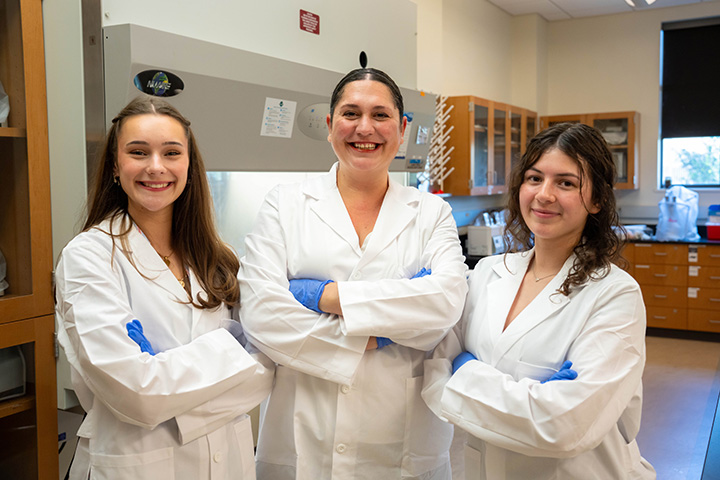
“We found out that these fungi were changing a lot in terms of how they look and how they behave,” she said. “They were behaving like pathogens — organisms capable of causing disease.”
Chavez joined A&M-San Antonio in 2026 and is an important new contributor to The Texas A&M University System’s expansive space exploration enterprise.
This fall, working in collaboration with Professor of Biology Davida Smyth, she plans to expand her research into space microbiology and antibiotic resistance to support space exploration efforts. She also plans to take select students to the American Society for Gravitational and Space Research Conference in Northern Virginia this November.
As NASA prepares to send astronauts deeper into space than ever before, Chavez hopes the next generation of scientists helping to further explore the last frontier will come from A&M-San Antonio.
"I really admire my students because they show so much enthusiasm and put in a lot of effort,” she said. "It has been really rewarding."